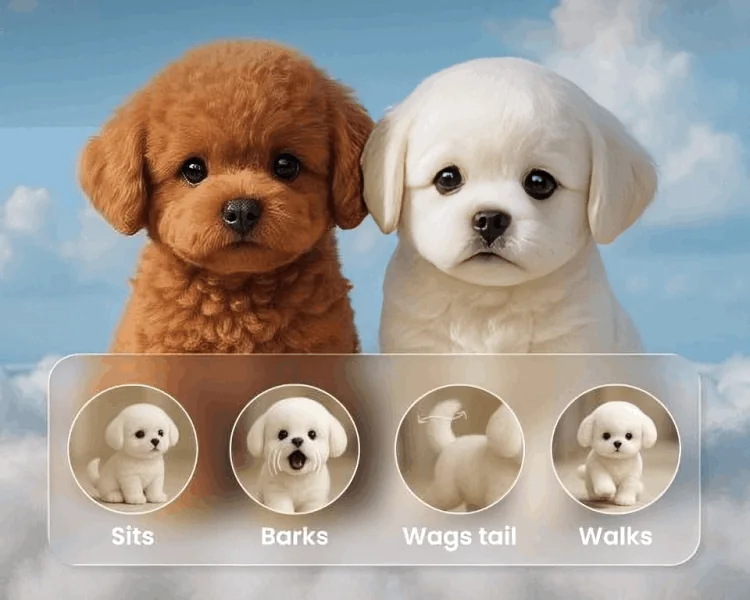
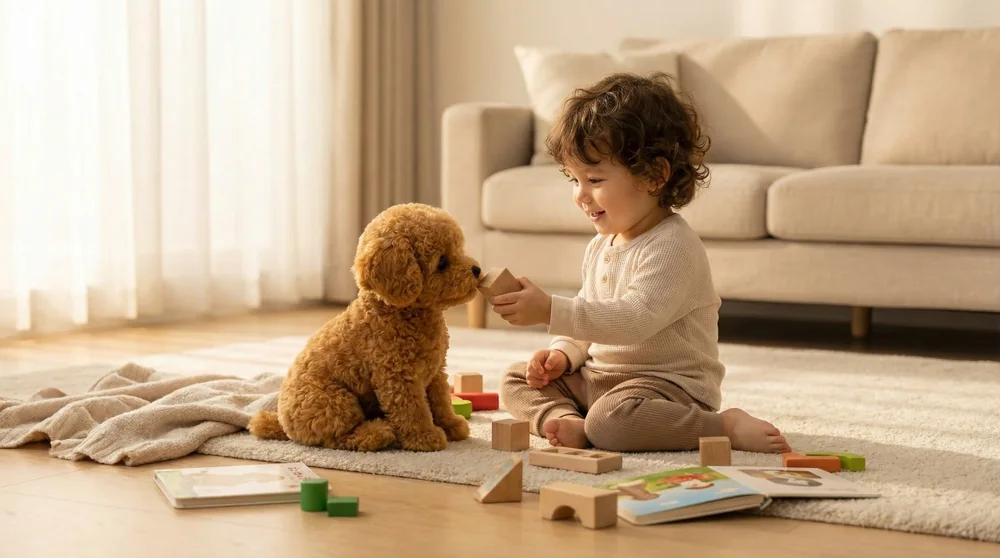
The Wuffy Robot Dog is designed to feel interactive and engaging while remaining simple, predictable, and safe for children. Unlike complex smart devices, it works using basic electronic components that respond to a child’s actions in clear and understandable ways.
This page explains how Wuffy works in practical terms, without technical jargon, so parents know exactly what to expect.
At its core, Wuffy follows a basic interaction loop:
Child action → internal response → visible reaction
When a child touches, moves, or speaks near the toy, Wuffy responds with movement or sound. These responses are pre-programmed and do not change over time, which helps keep play safe and easy to understand.

Wuffy is built with simple sensors commonly used in interactive toys. These sensors allow the toy to detect:
Touch or pressure from a child’s hand
Movement, such as being picked up or nudged
Basic sound cues in the environment
The sensors do not record or store information. They simply detect input in real time and trigger a response.
Inside Wuffy is a small control unit that determines how the toy reacts.
This internal system:
Interprets sensor input
Selects a matching response
Activates movement or sound
The toy does not think, learn, or adapt. Every response follows predefined rules designed during manufacturing.
Wuffy’s movement is intentionally limited and controlled.
Typical motion behavior includes:
Short, gentle movements
Dog-like actions such as turning or shifting
Pauses between actions
These limits help prevent overstimulation and reduce safety risks during play.
Wuffy may produce sounds that resemble playful dog behavior.
Sound features are designed to:
Be appropriate for children’s hearing
Respond only when interaction occurs
Avoid constant or looping noise
Some models may allow volume adjustment or have preset sound levels suitable for indoor play.
Wuffy operates using a built-in power source or batteries, depending on the model.
Parents should expect:
Simple on/off controls
Easy access for battery replacement or charging
Stable operation during normal play sessions
Battery compartments are typically secured to prevent child access.
Wuffy does not connect to the internet and does not require any external device to function.
This means:
No apps to install
No Wi-Fi or Bluetooth setup
No accounts or data sharing
All interaction happens physically, making play straightforward and screen-free.
Because Wuffy’s responses are pre-programmed, repeated play will produce familiar reactions.
For children, this can:
Create comfort through predictability
Encourage imaginative storytelling
Support nurturing or routine-based play
Parents may notice children incorporating Wuffy into broader pretend scenarios rather than focusing on the responses alone.
Understanding limitations helps set realistic expectations.
Wuffy does not:
Use artificial intelligence in a learning sense
Store or analyze data
Recognize individual users
Change behavior over time
Its simplicity is intentional and designed for safe, child-friendly interaction.
For children, especially younger ones, simple interaction often works better than complex systems.
Benefits of this design include:
Reduced frustration
Clear cause-and-effect learning
Easier independent play
Parents do not need technical knowledge to help children enjoy the toy.
Parents can support healthy play by:
Explaining that Wuffy responds because it is programmed
Encouraging imagination beyond the toy’s responses
Helping children understand the difference between toys and real pets
Clear explanations help children enjoy the toy without confusion.
The Wuffy Robot Dog works by responding to simple inputs with controlled movement and sound. Its design prioritizes predictability, safety, and screen-free interaction rather than complexity.
For parents, this means fewer setup steps, fewer concerns about data or screens, and a toy that fits naturally into everyday play. You can know more about Wuffy on the Overview page.